MOZART, Wolfgang Amadeus
Concerto for violin and orchestra No. 4 in D major K 218 (reduction for violin and piano)
I. Allegro
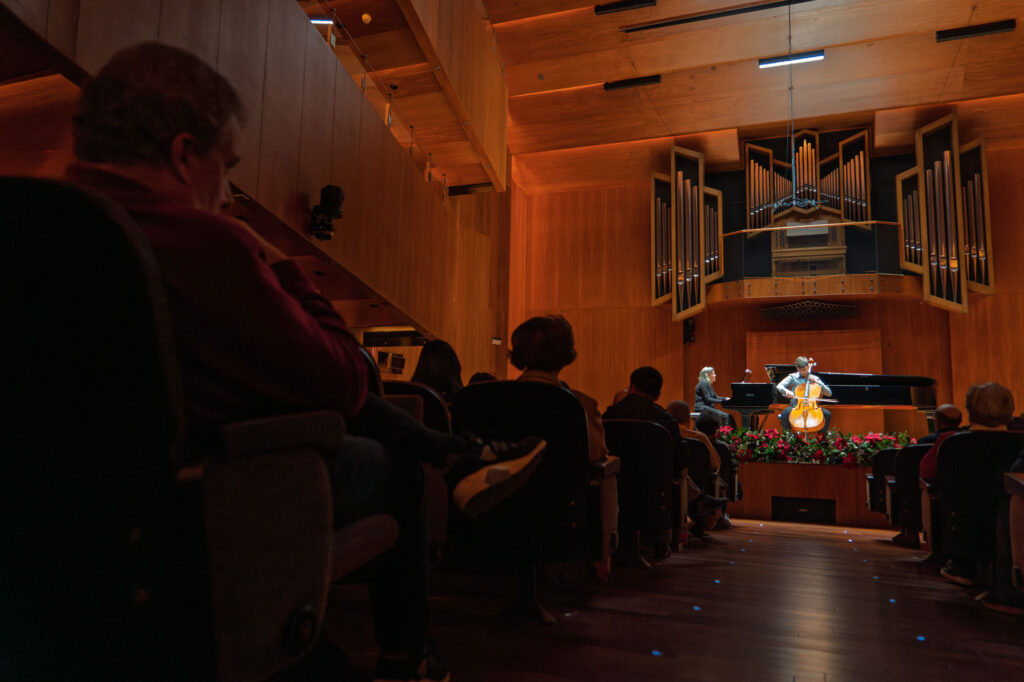
Nora Chastain, guest professor
Irene Herrero Martínez, student
Tomás Alegre, piano accompanist
After completing the performance of the first movement of Mozart’s Violin Concerto No. 4, Chastain congratulates the student on her sound and generally comments that she can improve in matters of intonation and language (certain accentuations, phrasing…). She asks if at home when she practices she plays more in tune and sounds better than in concert, and asks her to reflect on what changes when she is nervous, especially in her hands. When performing in public, if she is more conscious of analyzing the moments when something fails in articulation or intonation, paying attention to position changes, it can be useful for correcting it. Chastain also suggests that she can be more precise with the bow in certain passages, and plays some as an example to show her.
Resuming from the beginning, the professor makes observations regarding phrasing and articulation, seeking greater simplicity. One can play with more energy that does not necessarily mean playing louder or with more volume. She continues with indications regarding not making more phrasings than appropriate if the harmony remains constant, and proposes fingerings for that passage. At certain moments the professor also gives advice on how to practice specific passages, with a bow movement that helps to execute it naturally, and stopping at points mid-phrase to adjust it. With the orchestra, it is also not necessary to make so many dynamic changes in such a short time. They also slowly review the intonation at certain moments. Later on, it is important that she stay together with the orchestra; she can make a gesture with the bow to indicate when she is going to play and thus be in sync.
For Professor Chastain it is complicated to play Mozart with so many position changes and so forth, and she suggests finding a balance between an artistic interpretation and a practical and comfortable fingering (but one that logically respects the required phrasing).
Later on, for the rhythmic pattern that repeats up to 8 times, the professor proposes practicing it with changes in articulation and phrasing. This way the gestures can be more natural and free and it does not become monotonous.
Language: English